
Share


Drawdown governance service - Q3 2026 update to income sustainability scores
Income sustainability scores for Q3 2026 have now gone live for our drawdown governance service (DGS).
For many clients, scores are expected to remain broadly stable or be higher this quarter. This reflects the latest DGS model calibration as of 30 June 2026, together with changes to fund values from market movements since the last update in May.
Now is a good time to review your clients’ income plans and check whether any changes are needed. Logging in to DGS can help you identify clients whose sustainability scores have changed and where a follow-up could keep their plans on track.
The figures below have been produced using assumptions as at 30 June 2026.
What's driving change this quarter?
A number of factors can influence a client’s income sustainability score. The main drivers of change this quarter are:
Changes to expected investment returns
- Updates to the model’s expected investment returns can affect how sustainable a client’s income appears.
- For this quarter’s update, expected returns have increased across Global equities and bonds since the previous quarter, and there have been decreases in UK equities, bonds, and property.
Recent investment performance
- Scores reflect the current value of the client’s plan, including recent market performance.
- Fund values used for this update are as at 1 August 2026, and all Governed Retirement Income Portfolios (GRIPs) have delivered positive performance since the last update.
- This may improve sustainability for some clients.
Income taken and contributions
- Any income taken or contributions added since the last update will affect the client’s fund value.
- Extra withdrawals, or an increase in withdrawal amount may reduce sustainability, while additional contributions may improve it.
Changes in annuity rates (Income for Life clients)
- For clients targeting Income for Life (drawdown followed by annuity purchase), changes in annuity rates can impact their income outlook.
- Expected annuity rates have increased this quarter, which may support higher sustainability scores.
- Market annuity rates have also remained relatively high, continuing to support buying power for these clients.
Watch our latest market outlook for insight into investment performance and the factors influencing markets over the last quarter.
Our houseview
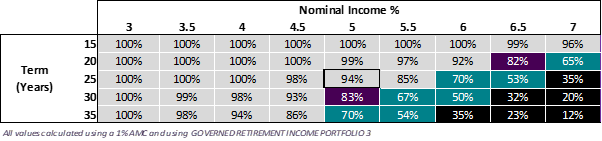
Our house view remains that, based on a typical scenario, a 5% nominal withdrawal rate may be sustainable for a client aged 65 entering drawdown and invested in Governed Retirement Income Portfolio 3 (GRIP 3) with a 1% AMC.
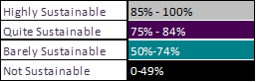
The table below sets out income sustainability scores across a range of nominal income levels and withdrawal terms for GRIP 3.
How sustainability scores are calculated
Income sustainability scores take into account a range of factors, including investment performance, changes in annuity rates, income levels and contributions. These are assessed alongside forward-looking economic assumptions to indicate whether a client’s income remains on track.
Further information on DGS, including how sustainability scores are calculated, is available in the User Guide within the DGS tool.